


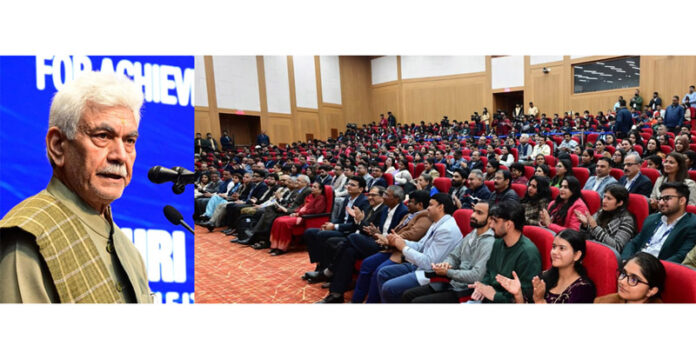
Lieutenant Governor Manoj Sinha announced significant progress in the fight against terrorism, revealing on Monday that large parts of India are now nearly terrorism-free. Speaking at the three-day Strategic Management Forum (SMF) Conference held at IIM Jammu, Sinha noted that local recruitment into terrorist activities in Jammu and Kashmir is almost non-existent.
In his address, Sinha highlighted that apart from a few pockets, most of the northeast region has successfully been cleared of terrorism. He stated, “Large parts of the country have been freed from terrorism. The threat posed by left-wing extremism and Naxalism has also significantly diminished, now confined to just two or three districts.”
Referring to the situation in Jammu and Kashmir, Sinha expressed confidence in the efforts of security forces. He declared that no top commander from terrorist organizations remains operational in the region. “Local recruitment into terrorism has seen a sharp decline. Hardly one or two youths are being recruited now,” he emphasized.
However, he cautioned against ongoing threats from Pakistan, which continues to attempt infiltrating terrorists across the border. “Those coming from across the border are hiding in dense forests and mountainous terrain. I assure you they will be eliminated. No matter how long it takes, they will not survive,” he asserted.
Notably, Sinha pointed out a worrying trend: the nature of terrorism is evolving, now involving educated individuals. He maintained that society, alongside security forces, must actively participate in the fight against terrorism, particularly in such sensitive areas as Jammu and Kashmir.
Highlighting the importance of unity in development, Sinha called for an end to the divisive ‘insider-outsider’ narrative that hinders progress. He stated that this mindset obstructs the necessary advancements needed in the region.
While outlining his vision for a Viksit Bharat by 2047, Sinha remarked that the roles of policymakers and business leaders are crucial in navigating challenges and capitalizing on opportunities in today’s rapidly transforming world. “Our focus should be on macroeconomic stability, high investment in education and health, leveraging digital tools, ensuring participatory governance, and implementing projects speedily and transparently,” he added.
During his address, Sinha also highlighted India’s unprecedented growth under the leadership of Prime Minister Narendra Modi. He noted an invigorated confidence among industry leaders with sectors like manufacturing, services, and handicrafts now competing globally.
Additionally, Sinha reaffirmed the need to utilize Jammu and Kashmir’s vast mineral wealth, which includes limestone, sapphire, and lithium. He estimated that with strategic planning, the region could generate an additional annual revenue of ₹15,000 to ₹20,000 crore within the next five to seven years. He urged for maximizing the hydropower sector and revising the Holistic Agriculture Development Programme (HADP) to align with the evolving economic landscape.
On the cultural front, Sinha inaugurated the Basohli Painting Exhibition and presided over the concluding session of the Basohli Painting Workshop, where he lauded the artists’ contributions to preserving this priceless artistic heritage.
The conference brought together eminent personalities including Prof B.S. Sahay, Director of IIM Jammu; R.K. Chaudhary, Chairman of the JERC for Jammu & Kashmir and Ladakh; and other policymakers, academicians, industry leaders, and artists.

