


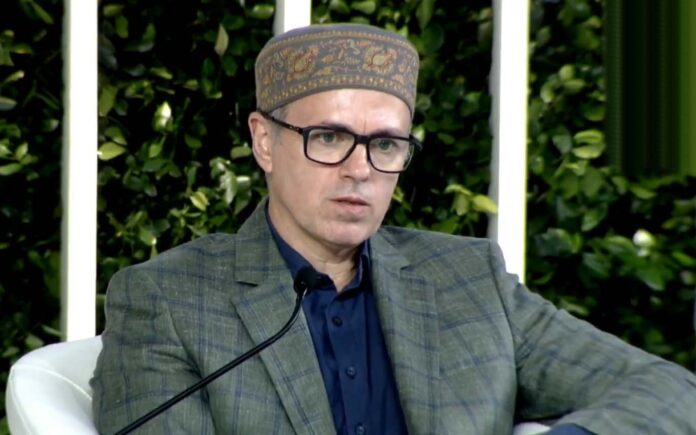
Former Chief Minister Omar Abdullah on Wednesday labeled his role as one of “disempowerment” amidst the ongoing political turmoil of Jammu and Kashmir (J&K). At a gathering organized by a national newspaper, he expressed regret over transitioning from leading a fully empowered state to governing a Union Territory (UT) with significantly less power.
Abdullah’s statements highlighted his concerns over frequent interventions by the Lieutenant Governor’s office, directly calling for a well-defined timeline for restoring the Statehood of Jammu and Kashmir. He articulated his struggle to reconcile the term “Union Territory” with “Jammu and Kashmir” and criticized the government’s portrayal of the rapidly evolving administrative framework.
“I find it very upsetting to be constantly reminded that we are now a Union Territory,” Abdullah remarked. He emphasized that during his tenure as Chief Minister, the reference to J&K as a state was natural, and now, the UT status is repeatedly underscored.
Referring to his power dynamics with the current administration, Abdullah pointed out the asymmetry in power distribution between elected officials and the unelected government. He specifically criticized Lieutenant Governor (LG) Manoj Sinha for reportedly assuming roles typically reserved for an elected government, serving as chairman of the Jammu and Kashmir Power Development Corporation while presiding over tourism-related meetings.
“It raises questions when a security official organizes a tourism conference,” he quipped, suggesting a disconnect between responsibilities and roles.
Moreover, Abdullah asserted that several cabinet decisions, including changes to reservation percentages, have stagnated with the LG, deepening the divide in governance from the central administration.
“The allocation of power currently favors the unelected other than the elected government in our region,” he said, echoing widespread grievances among regional political leaders.
Regarding the restoration of Statehood, Abdullah urged the central government to stick to the previously outlined three-step roadmap of delimitation, elections, and restoration. “With two steps already executed, what causes the hold-up for the last step?” he queried.
He challenged the Centre to articulate what it considers the “appropriate time” for this restoration. “If it hinges on the BJP’s electoral success, let them be transparent,” he stated, demanding accountability.
On the politically charged subject of Article 370, which previously granted autonomy to J&K, Abdullah drew attention to the increasing improbability of restoration under the current regime. “Requesting those who stripped us of our rights to reinstate them is futile,” he remarked, asserting his ongoing commitment to the concept of special status without making hollow promises.
Addressing growing concerns over radicalization, Abdullah condemned the government’s controversial approach of demolishing houses following terror incidents. He cited the demolition of homes post the Pahalgam attack as illustrative of a misguided approach to governance. “Was there Kashmiri involvement in that incident? We have found none,” he emphasized.
His commentary also touched upon societal divisions exacerbated by recent tensions surrounding the selection of candidates for sports teams and medical colleges, leading to concerns raised over perceived discrimination against community groups.
“Forcing a community to the fringes breeds resentment and reactions,” Abdullah warned, highlighting the need for inclusive governance.
On the national political landscape, Abdullah assessed the INDIA alliance’s state, likening it to being in “ICU”—indicative of its struggles to address critical issues such as Article 370. He defended Congress leader Rahul Gandhi’s subdued silence on this matter, noting the electoral implications of raising contentious topics in the current climate.
In a surprising departure from his father Farooq Abdullah’s mindset, Omar rejected allegations of electronic voting machine (EVM) tampering, advocating for ownership of electoral outcomes instead. He stated, “Mistakes must be acknowledged and rectified; we ought not to blame machines but rather understand the root causes of our failures,” attributing electoral imbalances to constituency delimitation.
Abdullah further discussed pressing environmental issues facing Jammu and Kashmir, highlighting pollution and prolonged dry spells affecting the Srinagar region. He clarified that while tourism often garners attention, it ranks fourth in economic contributions, following agriculture, horticulture, and industry in the state’s Gross Domestic Product.

