Aditya-L1’s HELIOS Captures India’s Maiden Sun Mission, Offering a Glimpse of Solar Flares
 Admin
0 comments
Admin
0 comments
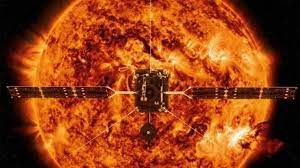
CHENNAI, Nov 8: India’s Aditya-L1, the nation’s maiden solar exploratory mission, has achieved a significant milestone by capturing the first glimpse of solar flares. This achievement marks a critical step in India’s space exploration and solar study endeavors. The spacecraft is currently on its journey to reach the Sun-Earth L1 point, which is located approximately 1.5 million kilometers from Earth.
The solar flares were successfully captured by the High Energy L1 Orbiting X-ray Spectrometer (HELIOS) on board the Aditya-L1 spacecraft. HELIOS is a crucial instrument designed to monitor the Sun’s high-energy X-ray activity with fast timing and high-resolution spectra. During its first observation period on October 29, 2023, HELIOS recorded the impulsive phase of solar flares, with data consistent with X-ray light curves provided by NOAA’s GOES.
Solar flares are sudden and intense brightenings of the Sun’s atmosphere, releasing an enormous amount of energy within a short period. They produce enhanced emissions in various wavelengths across the electromagnetic spectrum, including radio, optical, ultraviolet, soft X-rays, hard X-rays, and gamma-rays. Studying the early impulsive phase of solar flares, especially in hard X-rays, presents significant challenges due to the emission’s steep spectrum and rapid variability.
HELIOS aims to overcome these challenges with a set of detectors specifically tuned for different energy ranges, providing high spectral and time resolution measurements. This capability allows researchers to study explosive energy release and electron acceleration during the impulsive phases of solar flares.
The Aditya-L1 mission, launched by the Indian Space Research Organization (ISRO), is a space-based observatory dedicated to studying the Sun. Placed in a halo orbit around the Sun-Earth L1 point, it provides a continuous and uninterrupted view of the Sun, offering valuable insights into solar activities and their effects on space weather. Aditya-L1 has seven distinct payloads, including five developed by ISRO and two by Indian academic institutions in collaboration with ISRO.
This significant milestone in the Aditya-L1 mission demonstrates India’s commitment to advancing its space exploration capabilities and contributing to the global understanding of the Sun’s behavior and its impact on our planet.