


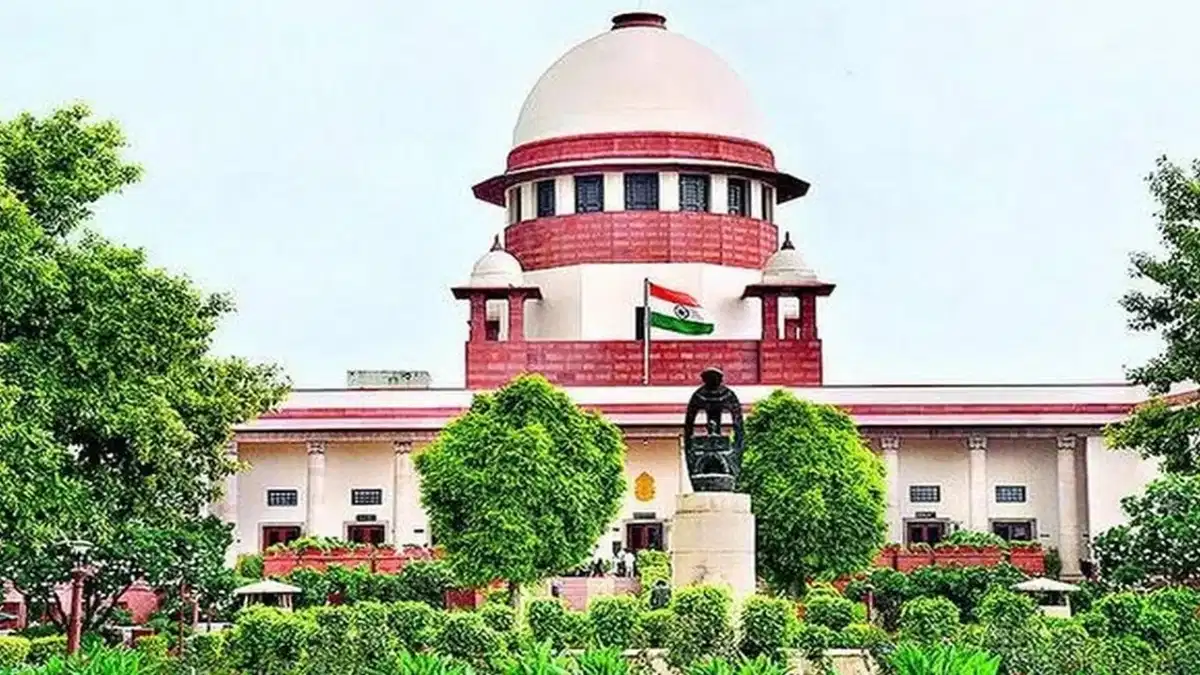
Srinagar, May 22: The Supreme Court of India has dismissed petitions seeking a review of its December 2023 judgment that upheld the government’s decision to revoke the special status of Jammu and Kashmir by abrogating Article 370 of the Constitution in August 2019.
A five-judge bench, led by Chief Justice of India D.Y. Chandrachud, stated, “Having perused the review petitions, there is no error apparent on the face of the record. No case for review under Order XLVII Rule 1 of the Supreme Court Rules 2013. The review petitions are, therefore, dismissed.” The bench also included Justices Sanjiv Khanna, B.R. Gavai, Surya Kant, and A.S. Bopanna. The petitions were dismissed on May 1, and the order was uploaded on the court’s official website on Tuesday.
In a landmark ruling on December 11, 2023, a Constitution Bench unanimously supported the Modi government’s August 2019 decision to revoke Jammu and Kashmir’s special status by abrogating Article 370. The original five-judge bench comprised CJI Chandrachud and Justices Sanjay Kishan Kaul, Sanjiv Khanna, B.R. Gavai, and Surya Kant. After Justice Kaul’s retirement on December 25, 2023, Justice Bopanna joined the reconstituted bench that reviewed the petitions.
In their December ruling, the bench issued three separate but concurring judgments, calling for the restoration of statehood “at the earliest” and setting a September 30, 2024, deadline for holding Assembly elections in the Union Territory of Jammu and Kashmir. The bench also upheld the validity of the Centre’s decision to create the Union Territory of Ladakh from the former state.
The Supreme Court confirmed the constitutional validity of two Presidential Orders—The Constitution (Application to Jammu and Kashmir) Orders 272 and 273, dated August 5 and 6, 2019—by which the entire Constitution of India was made applicable to Jammu and Kashmir, rendering all provisions of Article 370 inoperative. The bench stated that the princely state of Jammu and Kashmir “did not retain an element of sovereignty when” it joined the Union of India.
Regarding the reorganisation of the state into the Union Territories of Jammu and Kashmir and Ladakh in 2019, the bench dismissed the argument that the Bill under Article 3 required the state legislature’s consent, clarifying that such recommendations are advisory and not binding on Parliament.

