


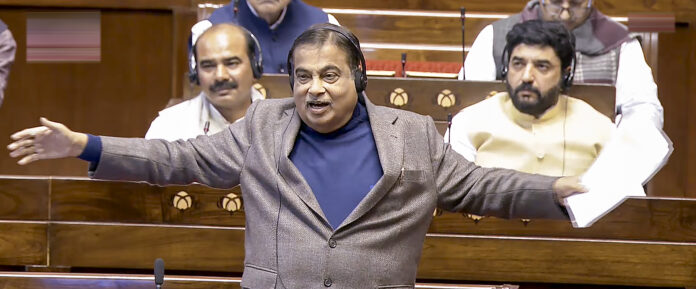
Union Minister for Road Transport and Highways Nitin Gadkari announced in the Rajya Sabha on Wednesday that India will implement the Multi-Lane Free Flow (MLFF) toll system and AI-powered highway management by the end of 2026. This initiative aims to enhance travel efficiency by eliminating wait times at toll plazas, significantly benefitting commuters across the nation.
During the Question Hour, Gadkari explained that the new tolling system leverages Artificial Intelligence, satellite technology, and advanced number plate recognition. This approach ensures that vehicles can seamlessly pass through toll points without stopping, thereby maintaining an uninterrupted driving experience.
“With the MLFF system, there’s no need for vehicles to stop at toll plazas. Commuters can drive through at speeds of up to 80 km per hour,” he stated, indicating a substantial upgrade from the current FASTag mechanism. He emphasized that this innovative system will replace the existing FASTag system.
Nitin Gadkari elaborated on the improvements brought about by the new tolling system. Previously, toll payments could take between three to ten minutes, which FASTag reduced to under a minute. “FASTag increased our revenue by at least ₹5,000 crore. The MLFF system promises even greater efficiency, with a goal of zero waiting time at tolls,” he asserted.
The Minister noted that the implementation of this new system could save fuel costs worth approximately ₹1,500 crore annually and generate an additional ₹6,000 crore in government revenue. He assured that the new system would effectively eliminate toll leakage and theft.
“By 2026, our goal is to complete this transition entirely. The shift to the MLFF system will bring about the end of toll theft, enhance transparency, and ensure a hassle-free experience for commuters at toll plazas,” Gadkari assured the members of the House.
He further asserted that the AI-enabled technology will enhance travel efficiency across national highways. This innovative approach aims to reduce overall travel times significantly, making long-distance travel more convenient and effective for millions of Indian road users.
In clarifying the roles and responsibilities regarding road management, Gadkari highlighted that the central government overlooks national highways, while state highways and urban roads fall under the jurisdiction of state governments. He mentioned that misinformation about national highways often circulates on social media.
“We are committed to instituting a transparent, efficient, and corruption-free system,” he stated, underlining the government’s focus on modernizing India’s highway infrastructure.
This announcement signifies a substantial leap toward modernizing India’s roadways, enhancing the travel experience for citizens nationwide. With advances like the MLFF toll system and AI-driven highway management, the government looks to empower road users to travel with ease and efficiency

