Locust swarms likely to enter Punjab, J&K shortly: Jammu scientist
 Admin
0 comments
Admin
0 comments
Asserting that in the recent years, Pakistan, Baluchistan have emerged as new breeding ground for locusts, a Jammu based renowned scientist said that the winged pest is expected to enter Punjab and the Union Territory of Jammu and Kashmir shortly.
“The pest is currently active in Gujarat, Maharashtra, Uttar Pradesh, and Madhya Pradesh and it is expected to enter Punjab and even Jammu and Kashmir shortly,” said Professor (Dr) R K Gupta, an Entomologist in Sher-e-Kashmir University of Agricultural Sciences and Technology, Jammu.
The scientist here said, “Since the past few days, winds are blowing at higher speed, it is likely that the swarming will be at a faster rate and the damage will be higher.”
This year, he expressed that locust attack is a matter of concern since, in previous locust plagues, the attacks were mostly restricted to Rajasthan but this year it is fast moving to other states as well.
Gupta said that in the past year’s findings on grasshopper attack over large areas of Kathua and Jammu, SKUAST-Jammu has concluded that their outbreak is related to declining population of rodents, birds and blister beetles which predate on eggs or mature stages of grasshopper.
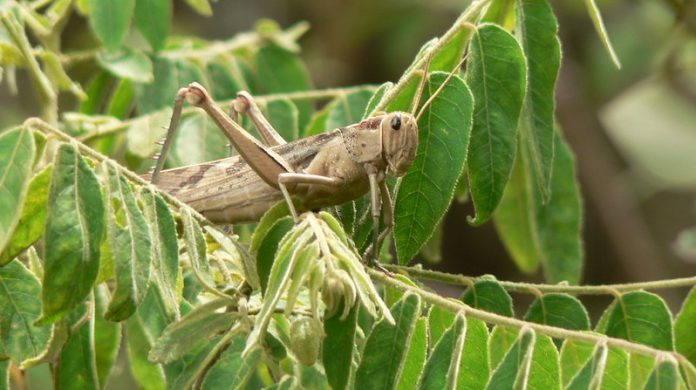
“Locusts are basically short-horned grasshoppers which one might have seen in the open field,” he added and said that the winds help the pest to minimize the energy spent by the flight muscles thereby consume more food than the normal.
“Normally, a swarm in one-km area eats the food as much as 35,000 people can but this year it is expected to be higher as under the prevailing circumstances of winds it can eat more and fly passively,” he added.
He further expressed that only four species of locusts are found in India comprising ‘Desert Locust’ (Schistocercagregaria), ‘Migratory Locust’ (Locustamigratoria), ‘Bombay Locust’ (Nomadacrissuccincta) and ‘Tree Locust’ (Anacridium SP).
“The desert locust is regarded as the most important one in India as well as internationally. Adult desert locust swarms can fly up to 150 km a day with the wind. In the absence of winds, the distance travelled by the adult insect remains lower,” he maintained and added that throughout history, India has remained at risk of a swarm invasion just before the onset of the monsoon. The swarms usually originate in the Horn of Africa after the harvest of summer crops and move onwards through strong southerly winds in mid-October towards Arabian Peninsula entering Iran and Pakistan and then drifts into other parts of western India.
Apart from a possible lack of food grains and vegetables, the Entomologist said that locust attacks on farms might also plunge India into fresh economic trouble.
“The Indian economy is already on the edge with COVID-19 pandemic and an agrarian crisis due to locust attack will add to the crisis,” he added.
Currently, locust outbreaks are managed using chemical insecticides or an insect fungus. Unfortunately, both strategies would make the locusts toxic, he added and said, “however, if we use the method of natural management, we can not only protect the crops from evil effects of chemicals but also take the benefit of food resource available in locust”.
By doing this, the nutritional benefits can outweigh the negative effects of chemical residues.
Gupta asserted that normally, these grasshoppers live in harmony with nature and do not pose any major economic threat to human beings and added, “even if we are able to kill their partial population in a few pockets, the leftover population escaping treatment takes off to rejoin the swarm”.
At present, the primary method of controlling desert Locust swarms is mechanical and chemical interventions, he added and said that while mechanical methods such as digging trenches, beating and burning are seldom effective, the chemical measures like baiting – scattering locust food impregnated with insecticide, dusting – applying fine dust impregnated with insecticide, spraying liquid insecticides mainly organophosphate chemicals applied in small concentrated doses (referred to as ultra low volume (ULV) formulation) by vehicle-mounted and aerial sprayers and to a lesser extent by knapsack and hand-held sprayers and hopper bands are not environment friendly.
“Processing locusts into raw material for compound feed production has been launched in Russia. The protein rich food can be stored as powder or flakes and sold as feed,” he said adding that for a natural outbreak of locust in India, community campaigns for large scale collection through handpicking, bags, buckets and traps should be organized.
“Through appropriate supply chain, they can further be processed into edible feed,” said the scientist adding that in ways like this, we can smartly utilize this locust attack for our own benefit and compensate for the loss that is expected.
This would be the most cost effective and environment friendly way of managing this noxious pest, he added.
Principal Secretary, Agriculture Production Department, Navin K Choudhary on May 28, batting for pre-emptive measures to foil any possible Locust attack in the UT, Principal Secretary, Agriculture Production Department, Navin K Choudhary asked Agriculture and allied departments to maintain high alert.
He ordered constitution of division and district level monitoring teams and involvement of scientists of SKUAST Kashmir and Jammu for making joint efforts against the possible threat.
Asking the concerned to be on high alert, he informed that locust menace has already destroyed standing crops and vegetation across Africa and large parts of West Asia.
“It is hyperactive currently in the neighbouring countries of Iran and Pakistan and has also entered India in the States of Rajasthan, Madhya Pradesh and Maharashtra. Our own neighbouring State Punjab is on high alert” he informed.
He also directed twin Agricultural Universities to constitute dedicated teams of scientists, who will analyze the pattern of influx and guide extension workers and farmers in tackling the menace.